
Digital Cinema Package. Put simply, its the digital equivalent of a 35mm print and it is the worldwide standard for screening your film in theaters. Conventionally, Post Houses will ship your film to your desired location on a CRU drive that look like this:
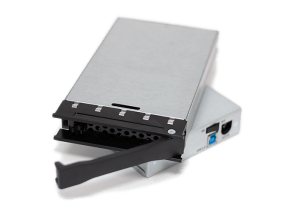
Most independent houses will likely deliver your film on an SSD or Lacie Drive but you’d need to be sure that’s acceptable for where you’re sending for distribution. We at NXTLVL typically deliver on CRU drives. There is no technical difference in using either type of drive, CRU drives are just traditional.
It is possible to deliver DCP files digitally but due to the size of the DCP file it is usually easier to ship it physically on a drive. DCPs have 8x more data on it than a blu ray, and 27x the data of a DVD. In addition, other than POS systems, theaters are not connected to any open internet sources for security reasons.
When you receive your drive, your machine will likely not be able to read or play the files. This is because they must be formatted for the Linux OS and use the Extended File System (EXT). The files on the drive will look something like the image below:

There are several different versions of the EXT format but the safest option that’s recognized by the most theaters is the EXT2 format simply because it has been the standard for so long even though EXT3 & EXT4 is more efficient.
There also other important things to consider when you know you are creating a DCP. Color, framerate, and sound.
The most noticeable thing to understand about DCPs is Color Space. While most videos are encoded in RGB or sRGB. DCPs utilize the X’Y’Z color space and they use this because it most closely emulates the film color gamut.

That is why screening in theaters looks slightly different than streaming at home but only slightly different. Its for this reason that NXTLVL Interactive performs QC checks on a projected screen and on several different monitors to ensure there are no abnormalities.
Next, framerates. There are two types of DCP formats used today; IOP & SMPTE. The older IOP format only supports 24fps or 48fps, while the newer SMPTE allows for a wider range of frame rates including 24, 25, 30, 48, 50, and 60.
Most Hollywood studios and almost all newer theaters have switched over to SMPTE as of 2019, however you may still encounter a theater that only supports the IOP format. Either way you are only allowed integer formatting which will require you to convert your 23.98 fps footage into 24fps most likely.
This means you’ll have to “conform” the footage by telling your project file to play each frame for a slightly shorter amount of time. Which means you’ll also have to account for this in your audio as by adding two-pops and tail-pops to ensure your audio is in sync.
Lastly, in regards to audio, a DCP requires a 5.1 or 7.1 mix. If you only have a stereo mix your DCP may get rejected by a movie theater, it simply won’t sound good and it will be excruciatingly loud.
For streaming deliverables this is typically not an issue, however your audio will sound “hollow and 1-dimensional” on older devices.
DCP FAQ
How much should a DCP Cost? A feature-length DCP can range in price from 1500.00 – 4000.00 not including hard drive costs. That price usually includes mastering, quality control, and (1) master DCP hard drive. Additional copies are usually less than $500.00 and can be as cheap as $150.00 if you provide the HD.
How long does it take to make a DCP? A DCP can comfortably generated in 5-7 business days.
Can I make a DCP myself? Yes, but it will not necessarily save you money. Because of the differences in frame-rates, audio, and color space the risks of not performing proper Quality Control will likely cost you the same or more.
My DCP got rejected, what now? The most common reason for DCP rejection is improper conforming or pull-downs. We can fix them by accessing your source files and conforming it on our end.
There you have it! if you know you are creating a DCP you should communicate that to your Post providers in advance for them to account for the slight differences DCP formatting. If you have any questions, reach out to us at any time via our Contact Page!
Written by: Cornell Mitchell, 11/29/2022
 NXTLVL Interactive